In 2008, Elon Musk was nearly broke. His rocket company had failed three launches in a row. His electric car company was months from collapse. He was going through a divorce, borrowing money from friends to pay rent, and the entire world was waiting for him to fail.
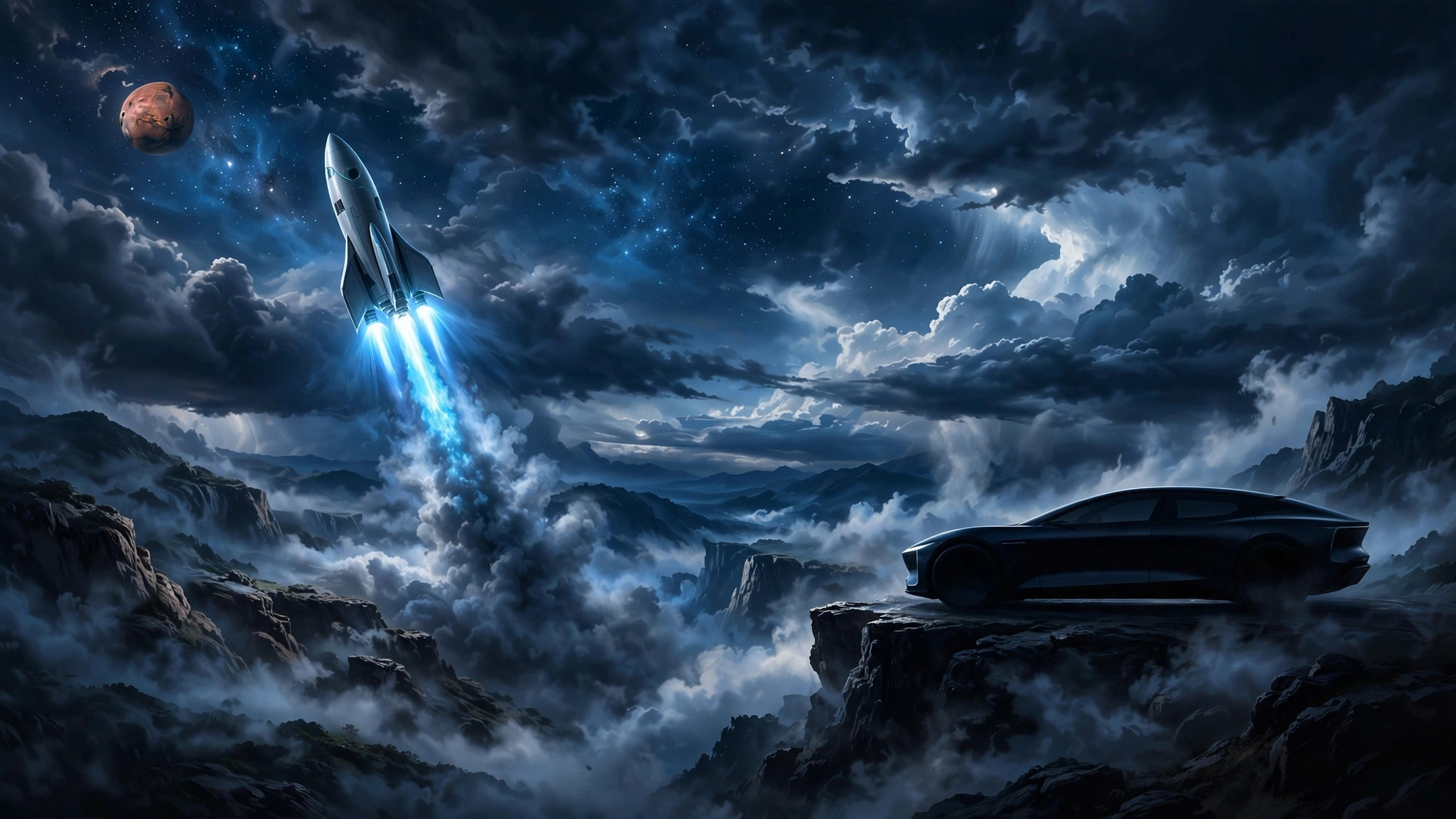
Most people would have quit. Musk did the opposite. He split his last money between the two dying companies — and bet everything on one final rocket launch and one final car delivery.
Both worked. And that single decision changed the future of cars, space travel, and the internet forever.
This is the story of how a quiet, bullied boy from South Africa became the most talked-about entrepreneur of our time.
A Difficult Childhood in South Africa
Elon Reeve Musk was born on June 28, 1971, in Pretoria, South Africa. His mother, Maye, was a model and dietitian. His father, Errol, was an engineer. From the outside, it looked like a comfortable family. Inside, it was not easy.
Musk has described his childhood as painful. He was a small, bookish boy who loved reading and computers — and that made him a target. He was severely bullied at school, once beaten so badly he had to be hospitalized. He has said those years shaped his toughness: when you survive that kind of pain as a child, business pressure later in life feels small by comparison.
But there was another side to young Elon. At age ten, he got his first computer. He taught himself programming and, at just twelve years old, created a video game called Blastar — and sold it to a computer magazine for five hundred dollars. It was the first sign of a pattern that would repeat for the rest of his life: learn fast, build something, sell it, and aim bigger next time.
Leaving Home With Almost Nothing
At seventeen, Musk left South Africa on his own. He moved first to Canada, where he did odd jobs — cleaning boilers, cutting logs — just to survive. Then he moved to the United States to study physics and economics at the University of Pennsylvania.
He was accepted into a PhD program at Stanford University in 1995. He lasted two days. The internet was exploding, and Musk decided he could not watch the biggest opportunity of his lifetime from a classroom. He dropped out and started his first company.
That decision tells you everything about how Musk thinks. He does not wait for permission. He does not wait for the safe moment. When he sees a wave forming, he jumps — even if he cannot swim yet.
Zip2 and PayPal: The First Fortunes
Musk's first company was Zip2, an online city guide for newspapers, which he started with his brother Kimbal in 1995. They had almost no money. They slept in the office and showered at a nearby YMCA. In 1999, the computer maker Compaq bought Zip2 for over three hundred million dollars. Musk, then twenty-seven, received about twenty-two million.
Most people would have retired. Musk put nearly all of it into his next idea: X.com, an online bank. X.com later merged with another startup and became PayPal. In 2002, eBay bought PayPal for one and a half billion dollars. Musk's share was around one hundred and eighty million.
He was thirty-one years old and wealthy beyond most people's dreams. And he was about to risk all of it.
SpaceX: The Company Everyone Laughed At
In 2002, Musk founded Space Exploration Technologies — SpaceX — with a goal so big it sounded like science fiction: make rockets reusable, cut the cost of space travel, and eventually send humans to Mars.
The experts laughed. Rockets were built by governments with unlimited budgets, not by a software millionaire with no aerospace experience. The first three Falcon 1 launches, between 2006 and 2008, all failed. Each failure burned tens of millions of dollars.
By late 2008, SpaceX had money for exactly one more launch. If it failed, the company was finished. On September 28, 2008, the fourth Falcon 1 reached orbit. Days later, NASA awarded SpaceX a one-point-six billion dollar contract. The company that everyone said would die had just been saved by its own stubbornness.
Then came the real revolution: reusable rockets. In 2015, SpaceX landed a rocket booster upright after launch — something many engineers had called impossible. Today, SpaceX launches more rockets than any company or country on Earth, and its Starlink satellites bring internet to remote places worldwide.
Tesla: Betting on Electric Cars
At the same time, Musk joined Tesla, a tiny electric car startup, in 2004. Again, the experts laughed. Electric cars were slow, ugly, and unprofitable — toys for hobbyists, not a real business.
Musk's approach was different. Instead of building a cheap electric car first, Tesla built an expensive sports car (the Roadster), then used that money to build a luxury sedan (the Model S), then used that money to build an affordable car (the Model 3). Each step funded the next.
In 2008, Tesla nearly died too. Musk personally poured his last money into it while also saving SpaceX. The Model S went on to become one of the most praised cars ever made, and the Model 3 became one of the best-selling electric cars in history. Tesla forced every major car company on the planet to take electric vehicles seriously.
The Method Behind the Madness
Musk's success is not luck. He follows a thinking method anyone can learn from:
First principles thinking. Instead of asking "how is this usually done?", he asks "what is actually true?" A rocket costs sixty million dollars because that is what rockets cost — or does it? Musk broke a rocket down to its raw materials and found they cost a tiny fraction of the price. The rest was just tradition and inefficiency.
Impossible deadlines. Musk sets timelines everyone calls crazy — and then pushes his teams to meet them. They often miss the date, but they achieve in two years what others planned for ten.
Total commitment. When SpaceX and Tesla were both dying in 2008, Musk did not diversify or play safe. He went all in. That kind of commitment is terrifying — and it is also why his companies survived when safer companies would have folded.
For another story of refusing to quit against impossible odds, read Steve Jobs Biography: The Man Behind Apple's Revolution.
Controversies and the Price of Ambition
No honest biography of Musk skips the difficult parts. His leadership style is famously intense — long hours, blunt feedback, and sudden decisions that have cost him talented people. His purchase of Twitter in 2022 for forty-four billion dollars, renaming it X, was one of the most debated business moves of the decade.
He has clashed with regulators, journalists, and governments. His public statements move markets and spark outrage in equal measure. Supporters call him the greatest innovator alive; critics call him reckless.
Both views contain truth. Musk's story is not a simple hero story. It is the story of a deeply driven, deeply flawed human being whose ambitions are larger than any one lifetime — and who keeps dragging the future closer, whether the world is ready or not.
What We Can Learn From Elon Musk
You do not need to build rockets to learn from Musk's life:
- Learn fast and build. At twelve he sold a video game. At twenty-four he built a company. He never waited to feel "ready."
- Question the price tag. Most limits are inherited, not real. Ask what things actually cost — in money, time, and assumptions.
- Survive the dip. Every one of Musk's companies nearly died. The difference between failure and legend was surviving one more launch, one more quarter.
- Think in decades. Musk plans for Mars while competitors plan for next quarter. Long timelines unlock moves that short ones cannot.
Beyond Rockets and Cars: Neuralink, Starlink and X
Tesla and SpaceX would be enough for three lifetimes. Musk kept going.
Starlink grew out of SpaceX's rocket expertise: thousands of small satellites in low orbit, beaming internet to places cables will never reach — remote villages, ships at sea, war zones. It turned SpaceX from a launch company into a global telecom provider, and it now funds the Mars program.
Neuralink, founded in 2016, is trying to build brain-computer interfaces — tiny implants that could one day help paralyzed people control devices with their thoughts, and eventually treat neurological conditions. It is the most science-fiction of all his bets, and the furthest from paying off. But that has never stopped him before.
X — the former Twitter, bought for forty-four billion dollars in 2022 — is Musk's attempt to build an "everything app": payments, video, messaging, and commerce in one place. It has been chaotic, controversial, and financially painful. Whether it becomes a masterstroke or an expensive lesson is still undecided.
Then there is xAI, his artificial intelligence company, launched to compete in the AI race he helped start years earlier (he co-founded OpenAI in 2015 before leaving over disagreements about its direction).
The pattern is consistent: Musk does not enter industries — he enters futures. He picks the technologies that will define the next fifty years and starts building before anyone else believes.
The Mars Vision: Why It All Points One Way
Ask Musk what it is all for, and the answer is always the same: Mars.
He has said repeatedly that he wants humanity to become a multi-planetary species — not as a luxury, but as insurance. A single-planet civilization, in his view, is one asteroid strike or catastrophe away from extinction. SpaceX's Starship — the largest rocket ever built — is designed for exactly this: carrying a hundred people at a time to the Red Planet.
Critics call it escapism: why spend billions on Mars when Earth has so many problems? Musk's answer is that the technologies developed for Mars — reusable rockets, closed-loop life support, cheap satellite internet — solve Earth's problems too. Starlink already does.
Whether humans reach Mars in Musk's lifetime is uncertain. What is certain is that one man's obsession with the Red Planet has already pulled the entire space industry a decade forward.
Watch the Full Documentary
Want the complete cinematic version of this story — from the bullied kid in Pretoria to the man reshaping technology? Watch it here:
If this story inspired you, explore more lives of remarkable people — like Elon Musk's First Principles: Solve Problems Like a Genius, another man who refused to accept the word impossible.
Leave a Reply