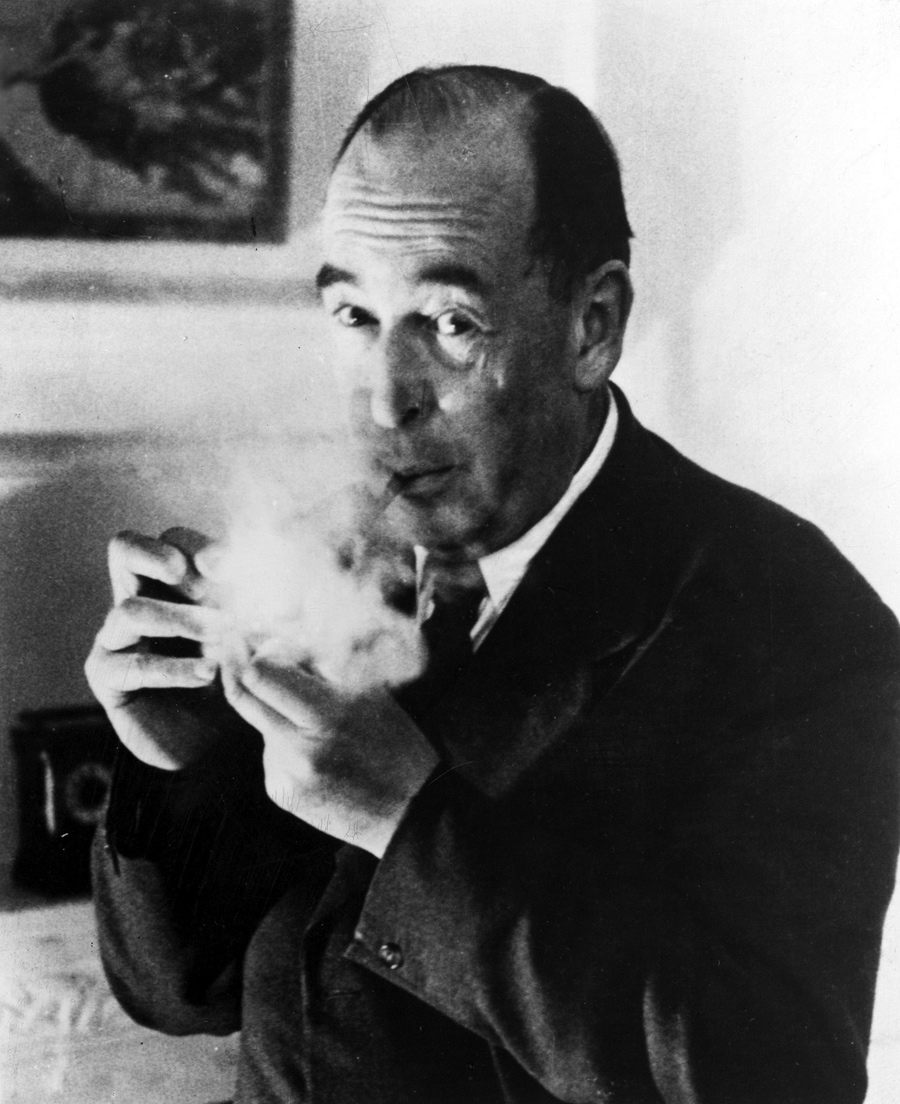
C. S. Lewis (1898–1963) was an Oxford scholar, a storyteller, and one of the most widely read writers of the twentieth century. He is best known as the author of The Chronicles of Narnia, seven children’s books that have delighted readers for more than seventy years, and of Mere Christianity, a plain-language explanation of the Christian faith still in print today. His life took him from Belfast to the battlefields of the First World War, and from a young man’s atheism to a faith that shaped everything he wrote.
Early Life in Belfast
Clive Staples Lewis was born on 29 November 1898 in Belfast, in what is now Northern Ireland. His father, Albert James Lewis, was a solicitor, and his mother, Flora Augusta Hamilton Lewis, was the daughter of a clergyman. He had one older brother, Warren, known to the family as Warnie, who was three years his senior. The two brothers were close all their lives.
As a young boy, Lewis invented imaginary worlds with his brother, filling notebooks with stories about animals, knights, and faraway lands. When he was four years old, the family dog Jacksie was killed in an accident, and the young Clive announced that he would now be called Jack. The name stayed with him for the rest of his life.
His happy childhood was broken in 1908, when his mother died of cancer. Lewis was only nine years old. His father sent both boys to boarding school in England. Lewis was unhappy at his first school, Wynyard, and later at Campbell College in Belfast and Malvern College in England. The turning point came when his father arranged for him to be tutored privately by William T. Kirkpatrick, a demanding teacher known as “the Great Knock.” Kirkpatrick taught Lewis to think clearly, to argue carefully, and to love the Greek and Latin classics. Under his guidance, Lewis won a scholarship to University College, Oxford.
Education, War, and Oxford
Lewis arrived at Oxford in 1917, but his studies were soon interrupted by the First World War. He joined the Somerset Light Infantry as an officer and was sent to France. In April 1918, during the Battle of Arras, he was wounded by shrapnel and sent back to England to recover. A close friend from his army days, Paddy Moore, was killed in the fighting, and Lewis kept a promise to look after Moore’s mother, Janie Moore, for the rest of her life.
After the war, Lewis returned to Oxford and excelled. He took first-class degrees in classical studies, philosophy, and English. In 1925, he was elected a Fellow and Tutor in English Literature at Magdalen College, Oxford, a position he would hold for nearly thirty years.
Career: Scholar, Teacher, and the Inklings
Lewis’s academic career was distinguished. His first major scholarly book, The Allegory of Love (1936), a study of medieval poetry, established him as a serious scholar. He later wrote A Preface to Paradise Lost (1942) and the volume on sixteenth-century literature in the Oxford History of English Literature (1954). In 1954, he left Oxford to become Professor of Medieval and Renaissance Literature at Magdalene College, Cambridge, where he taught until shortly before his death.
Outside the lecture hall, Lewis was part of a famous circle of friends called the Inklings. The group met regularly in Oxford to read aloud from works in progress and to talk about literature, language, and faith. Among its members were J. R. R. Tolkien, author of The Hobbit and The Lord of the Rings, and Charles Williams, a poet and novelist. The Inklings often gathered at the Eagle and Child pub, affectionately known as “the Bird and Baby.” Tolkien’s encouragement and criticism mattered greatly to Lewis, and their friendship shaped both men’s writing.
As a young man, Lewis had left the Christianity of his childhood and described himself as an atheist. His return to faith was gradual. Long conversations with Tolkien, Hugo Dyson, and others, together with his reading of writers such as George MacDonald and G. K. Chesterton, changed his mind. He later wrote that he came to believe in God in 1929, and accepted the Christian faith in 1931. He described his conversion in his autobiography, Surprised by Joy (1955).
During the Second World War, Lewis gave a series of radio talks on the BBC explaining Christianity in simple, everyday language. The talks made him a well-known public figure, and they were later collected into the book Mere Christianity (1952). He also wrote The Screwtape Letters (1942), a witty and unsettling novel told as letters from a senior demon to a junior tempter, and The Problem of Pain (1940), The Great Divorce (1945), and The Abolition of Man (1943).
Major Achievements
Lewis’s greatest popular achievement was The Chronicles of Narnia, seven fantasy novels published between 1950 and 1956. The series began with The Lion, the Witch and the Wardrobe (1950), in which four children step through a wardrobe into a magical land ruled by the White Witch, and meet Aslan, the great Lion. The other books are Prince Caspian (1951), The Voyage of the Dawn Treader (1952), The Silver Chair (1953), The Horse and His Boy (1954), The Magician’s Nephew (1955), and The Last Battle (1956), which won the Carnegie Medal for children’s books.
The Narnia books have sold more than 150 million copies and have been translated into dozens of languages. They have been adapted for radio, television, the stage, and film, including the BBC television series and the 2005 film The Chronicles of Narnia: The Lion, the Witch and the Wardrobe. A new film adaptation has been announced, bringing Lewis’s world to a new generation.
Lewis was also a gifted writer of science fiction. His Space Trilogy — Out of the Silent Planet (1938), Perelandra (1943), and That Hideous Strength (1945) — carried his interests in science, morality, and faith into imagined worlds. His novel Till We Have Faces (1956), a retelling of the myth of Cupid and Psyche, was the book he himself considered his best work.
Personal Life: Marriage to Joy Davidman
In 1956, Lewis married Joy Davidman, an American writer and poet. The marriage began as a civil arrangement to allow Davidman, whose visa was expiring, to remain in Britain, but the two grew to love each other. When Davidman was diagnosed with cancer, Lewis married her in a church ceremony in 1957. Her illness went into remission for a time, and the couple enjoyed happy years together before her death in 1960. Lewis wrote about his grief in A Grief Observed (1961), published at first under a pen name, a short and honest book that has comforted many readers facing loss.
Lewis died on 22 November 1963, at the age of 64, at his home, The Kilns, in Headington, near Oxford. The same day brought the assassination of President John F. Kennedy, and Lewis’s death received little attention in the newspapers. He is buried in the churchyard of Holy Trinity Church in Headington Quarry, Oxford.
Legacy
C. S. Lewis left a legacy that crosses many fields. As a scholar, he helped readers understand medieval and Renaissance literature. As a Christian writer, he explained deep ideas in simple words, and his books are still given to people exploring faith for the first time. As a storyteller, he helped shape modern fantasy writing alongside his friend Tolkien, and the Narnia books remain among the most loved children’s books ever written.
His influence continues in many forms: societies and study centres devoted to his work, stage and screen adaptations, and new editions of his books that reach readers every year. Perhaps his lasting gift is the way he wrote — with warmth, humour, and common sense — about both imaginary worlds and the real questions of life: courage, kindness, suffering, and hope.
Quick Answers: C. S. Lewis FAQ
Who was C. S. Lewis?
C. S. Lewis (1898–1963) was a Northern Irish-born writer and scholar who taught at Oxford and Cambridge. He wrote The Chronicles of Narnia, Mere Christianity, The Screwtape Letters, and many works of scholarship, fiction, and poetry.
What is C. S. Lewis most famous for?
He is most famous for The Chronicles of Narnia, seven fantasy novels beginning with The Lion, the Witch and the Wardrobe (1950), and for his Christian writings, especially Mere Christianity and The Screwtape Letters.
Was C. S. Lewis friends with J. R. R. Tolkien?
Yes. Lewis and Tolkien were close friends and fellow members of the Inklings, a group of Oxford writers who met to share their work. Tolkien played an important part in Lewis’s return to the Christian faith, and the two men influenced each other’s writing.
When did C. S. Lewis die?
Lewis died on 22 November 1963, at his home near Oxford, at the age of 64. He is buried in the churchyard of Holy Trinity Church, Headington Quarry, Oxford.
If you enjoyed this biography, explore more lives of writers, scientists, and leaders on World Biographies.
Leave a Reply