In 1905, a twenty-six-year-old clerk in a Swiss patent office published four scientific papers in a single year. He had no university position, no laboratory, no research team. He reviewed other people's inventions six days a week and did his own thinking in the evenings.
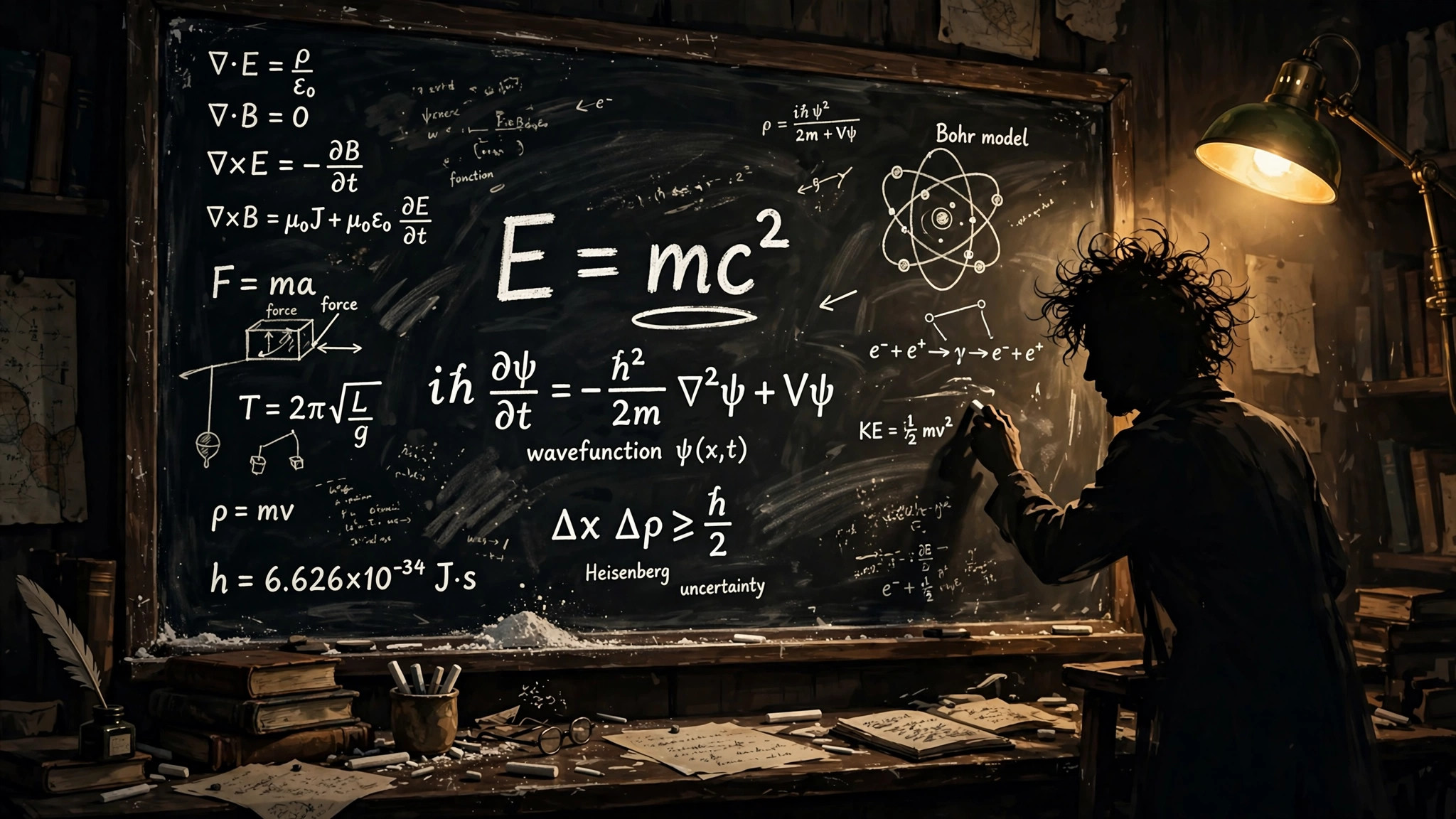
Those four papers changed physics forever. One contained the most famous equation in history: E=mc². Another quietly overthrew three hundred years of thinking about time and space.
The clerk was Albert Einstein — the boy the world had once dismissed as slow and dreamy, soon to be called the greatest genius of his century.
A Slow Child? The Myth and the Reality
Albert Einstein was born on March 14, 1879, in Ulm, in southern Germany. His father, Hermann, ran a small electrical business; his mother, Pauline, was a talented pianist.
There is a popular story that Einstein did not speak until he was four, and that his teachers thought he was slow. He did start speaking later than most children — quietly repeating sentences to himself before saying them aloud. But he was never a poor student: he excelled at mathematics from an early age and taught himself advanced geometry as a teenager. What was true is that he hated school rules and memorizing facts, preferring to think.
One childhood moment stayed with him forever. When he was about five, his father showed him a compass, and the boy was fascinated: no matter how he turned it, the needle always pointed north. Something invisible was guiding it. That sense of wonder — that hidden forces shape the world — never left him.
The Patent Office Years
Einstein studied physics at the Swiss Polytechnic in Zurich, graduating in 1900. But his rebellious attitude had annoyed his professors, and none would recommend him for a university job. After two years of tutoring and odd jobs, a friend helped him join the Swiss patent office in Bern in 1902.
It was not glamorous, but it had two hidden gifts: it paid enough to live on, and it left his evenings — and his mind — free. While classmates with university positions were busy teaching, Einstein had time to think about the deepest questions in physics.
He was also starting a family. In 1903, he married Mileva Marić, a fellow physics student; the marriage ended in divorce in 1919.
1905: The Miracle Year
Then came 1905 — Einstein's "miracle year." In about four months, working alone in his spare time, he published four papers that each could have made a career on its own.
Paper one: light comes in packets. Einstein proposed that light arrives in tiny packets of energy, called quanta — explaining why light can knock electrons off metal. It became a foundation of quantum physics.
Paper two: proof that atoms exist. He explained the jittery motion of tiny particles floating in water (Brownian motion) — an explanation that only worked if invisible atoms were bumping into them. Many scientists still doubted atoms were real; his paper helped settle it.
Paper three: special relativity. Einstein showed that time and space are not fixed and absolute, as everyone since Newton had believed — they stretch and squeeze depending on how fast you move.
The simple version: experiments showed light always travels at the same speed (about 300,000 km per second), no matter how fast its source moves. Einstein followed that strange fact to its conclusion — if light's speed never changes, then time must slow down and distances must shrink for fast-moving travelers, so the math still works. A century of experiments has confirmed it.
Paper four: E=mc². Mass and energy, he showed, are two forms of the same thing — and because the speed of light is such an enormous number, a tiny amount of mass holds a gigantic amount of energy. It explains how the sun shines and, tragically, made the atomic bomb possible.
Four papers. One year. A patent clerk. Physics would never be the same.
If you want these ideas broken down even further, read Einstein's Relativity Explained Simply: A Beginner's Guide.
General Relativity: Gravity Reimagined
Einstein was not finished. Special relativity ignored gravity, so for ten years he wrestled with a bigger theory. In 1915 he published general relativity, with a beautiful central idea: gravity is not a force pulling objects together, as Newton had said. Massive objects like the sun curve the fabric of space and time around them — and planets simply follow the curves, like marbles rolling around a dent in a stretched rubber sheet.
It predicted that starlight passing near the sun should bend — and in 1919, during a solar eclipse, British astronomers measured exactly that. Einstein became the most famous scientist alive overnight.
The theory also predicted that time runs slower near massive objects (your phone's GPS corrects for this daily) and that violent cosmic events send ripples through space-time called gravitational waves — finally detected in 2015, one hundred years after the theory.
The Nobel Prize — But Not for Relativity
In 1921, Einstein received the Nobel Prize in Physics — but not for relativity. The committee awarded it for his 1905 paper on the photoelectric effect, which had solid proof, while relativity still seemed too controversial. He was not even at the ceremony; he was traveling in Japan when the prize was announced.
It is one of history's great ironies: the most famous scientific theory ever written was not the one that won its author the Nobel Prize.
Fleeing Nazi Germany
By the 1930s, Einstein was world-famous — and in danger. He was Jewish and outspoken against militarism, living in Germany as Hitler and the Nazi party rose to power. In 1933, the Nazis seized his property, burned his books, and put a price on his head.
Einstein never returned to Germany. He accepted a position at the Institute for Advanced Study in Princeton, New Jersey, and lived there for the rest of his life — in a modest house, walking to work, chatting with neighbors who often had no idea who he was.
In 1939, as World War II approached, Einstein signed a famous letter to U.S. President Franklin Roosevelt, warning that Germany might be developing atomic weapons. The letter helped launch the Manhattan Project. Einstein later called signing it the greatest mistake of his life — if he had known Germany would fail to build the bomb, he said, he would never have lifted a finger.
The Pacifist in Princeton
For his last thirty years, Einstein chased a single, unfinished dream: a unified theory combining all the forces of nature into one framework. He never found it, but he believed the search itself was worth a lifetime.
Outside science, he used his fame for pacifism, civil rights, and a Jewish homeland. He called racism America's worst disease, and in 1952 Israel offered him its presidency — he declined, saying he lacked the practical skills, but was deeply moved.
He remained, to the end, a rebel with a violin: playing chamber music, sailing badly but happily, and refusing to wear socks because he found them pointless.
Death and the Brain That Would Not Rest
On April 18, 1955, Albert Einstein died in Princeton Hospital from a burst blood vessel near his heart. He was seventy-six. He had refused surgery, saying he had done his share and wanted to go elegantly. His brain was removed during the autopsy without his family's permission and studied for decades — but no simple physical secret of genius was ever found.
What We Can Learn From Albert Einstein
You do not need to rewrite physics to learn from Einstein:
- Question everything. He took nothing on authority — not Newton, not his teachers, not common sense. Asking "but is it really true?" is available to anyone.
- Boring jobs can hide great minds. The patent office gave him what universities could not: time to think.
- Imagination beats memorization. Einstein said imagination was more important than knowledge.
- Use fame for good. He spent his influence on peace and justice, not just on himself. A big voice carries big responsibility.
Watch the Full Documentary
Want the complete cinematic version — from the compass in Ulm to the eclipse that made him world-famous? Watch it here:
If this story inspired you, explore more lives of remarkable people — like Steve Jobs Biography: The Man Behind Apple's Revolution, another outsider who saw the world differently and changed it forever.
Quick Answers
When was Albert Einstein born? March 14, 1879, in Ulm, Germany. He died on April 18, 1955, in Princeton, New Jersey, at seventy-six.
What is E=mc² in simple terms? It means mass and energy are two forms of the same thing. Because the speed of light is so huge, a tiny bit of mass holds an enormous amount of energy — which is why the sun shines and why atomic energy is so powerful.
What did Einstein win the Nobel Prize for? The 1921 Nobel Prize in Physics, for explaining the photoelectric effect — not for relativity, which the committee considered too unproven.
What was Einstein's miracle year? 1905, when he published four groundbreaking papers — on light quanta, atoms, special relativity, and E=mc² — while working as a patent clerk.
Why did Einstein leave Germany? He was Jewish and an outspoken critic of militarism. When the Nazis took power in 1933, they seized his property and targeted him, so he moved to America and never returned.
Did Einstein really fail math in school? No — this is a myth. He was excellent at mathematics from childhood and taught himself advanced geometry as a teenager. He simply disliked rote memorization and strict teachers.
Conclusion: The Genius Who Stayed Human
Albert Einstein surprised the world twice: first as a slow-talking child who became a revolutionary thinker, then as a patent clerk who rewrote the laws of the universe in his spare time. He gave us relativity, E=mc², and the foundations of modern physics — with curiosity, imagination, and a lifelong refusal to accept that things must be the way they have always been.
But perhaps his greatest lesson is not scientific at all. Genius is not about being the smartest person in the room. It is about wondering longer, questioning deeper, and staying curious until the very end.
If you enjoyed this biography, keep exploring more remarkable lives on our blog — from scientists and inventors to leaders and visionaries, every story holds a lesson worth learning.
Leave a Reply