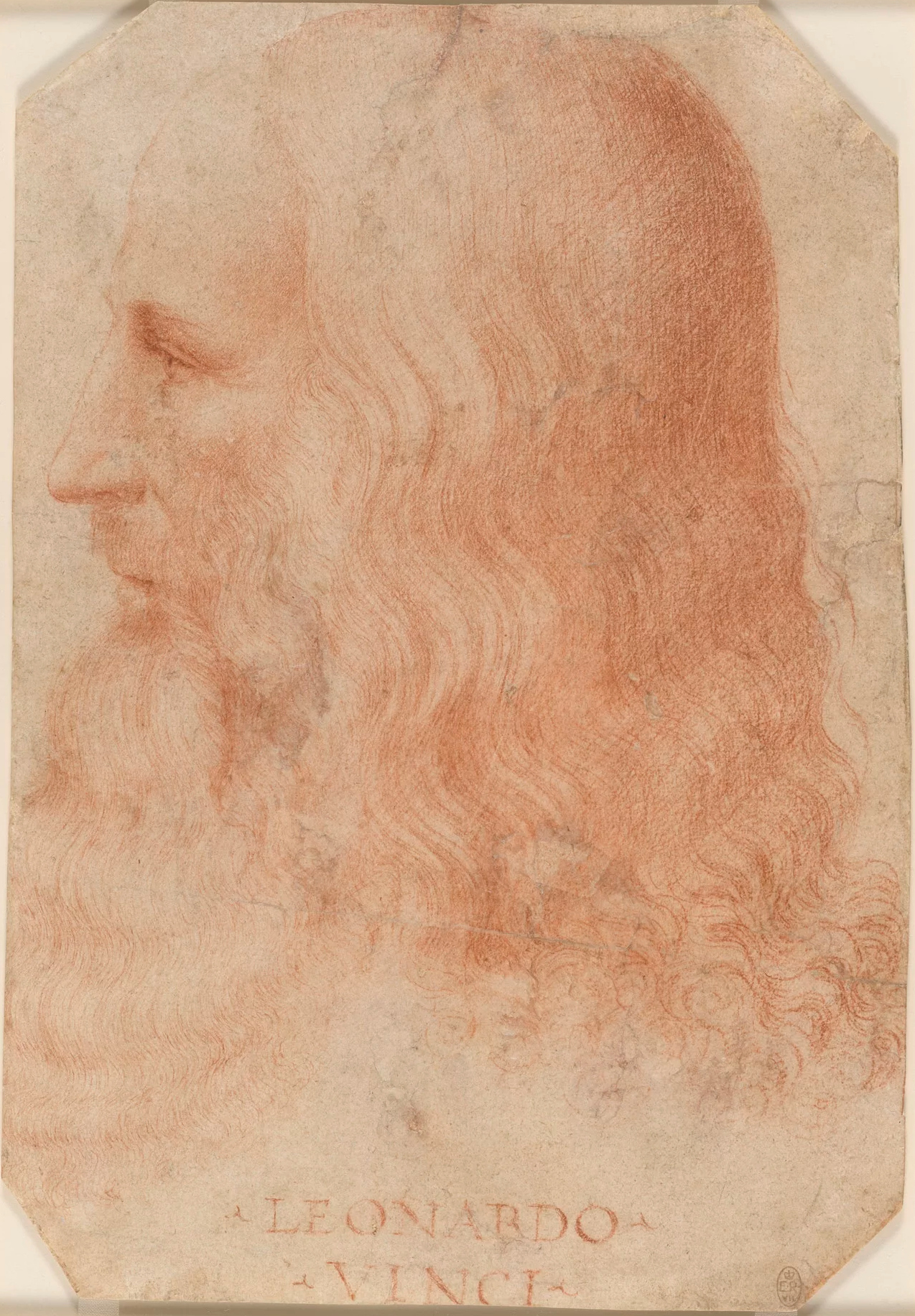
Five hundred years ago, in a small Italian hill town, a curious boy spent his days watching birds circle the sky and sketching the way water flows around stones. That boy grew up to paint the most famous smile in the world — and to design a flying machine four hundred years before the first aeroplane. His name was Leonardo da Vinci.
Leonardo da Vinci (1452–1519) was an Italian artist, inventor, and scientist. He painted the Mona Lisa and The Last Supper, two of the most famous artworks ever created. But painting was only one part of his life. His notebooks — around 5,000 pages of sketches and notes — are filled with designs for helicopters, tanks, parachutes, and detailed studies of the human body. He is remembered as the original “Renaissance man”: a person who tried to master every field of knowledge.
Early Life
Leonardo was born on 15 April 1452 in the village of Vinci, near Florence, in what was then the Republic of Florence. He was the son of a notary, Ser Piero da Vinci, and a peasant woman named Caterina. His parents were not married, so Leonardo grew up outside the usual path — but his father recognised his talent and found him a way into the world of art.
As a child, Leonardo was endlessly curious. He drew plants, animals, and landscapes, and he asked questions about everything: how birds fly, how water moves, how the human eye sees. When he was about fourteen, his father apprenticed him to Andrea del Verrocchio, the most famous artist in Florence. In Verrocchio’s workshop, Leonardo learned painting, sculpture, drawing, and even metalwork and engineering.
A famous story says that when the young Leonardo painted an angel in Verrocchio’s Baptism of Christ, it was so beautiful that the master — according to the artist biographer Vasari — put down his brush and never painted again. The story may be legend, but the talent was real. In 1472, at twenty, Leonardo was accepted as a master in Florence’s painters’ guild, the Guild of Saint Luke.
Career and Masterpieces
In 1482, Leonardo left Florence for Milan, where he offered his services to the ruler Ludovico Sforza. In his famous job letter, he barely mentioned painting — he presented himself as a military engineer who could build bridges, weapons, and war machines. Sforza hired him, and Leonardo spent seventeen years in Milan as painter, engineer, and court organiser of festivals.
It was in Milan that Leonardo created The Last Supper (1495–1498), painted on the wall of the dining hall of the monastery of Santa Maria delle Grazie. Instead of using the traditional fresco method, Leonardo experimented with oil paint on dry plaster, hoping for softer colours. The experiment failed — the painting began to flake within his own lifetime — but the image of Christ and the twelve apostles at the moment of betrayal became one of the most reproduced artworks in history.
Back in Florence around 1503, Leonardo began the portrait that would make him immortal: the Mona Lisa. He worked on it for years, carrying it with him everywhere, and it was still in his studio when he died. Using a technique called sfumato — soft, smoky shading with no hard lines — he gave the woman’s smile its mysterious, shifting quality. The sitter was probably Lisa del Giocondo, a merchant’s wife, though this has never been proven beyond doubt. Today the painting hangs in the Louvre in Paris.
Leonardo’s other great works include Lady with an Ermine, a striking portrait painted in Milan now in Kraków, and The Vitruvian Man (around 1490), the famous drawing of a man inside a circle and a square that became a symbol of the Renaissance. Only about fifteen to twenty paintings are confidently attributed to him — he was a perfectionist who left many works unfinished, his attention always pulled toward the next question.
Inventor and Scientist
Painting alone does not explain Leonardo’s fame. His notebooks contain ideas centuries ahead of their time: a flying machine with flapping wings (the ornithopter), an aerial screw that looks like a helicopter, an armoured fighting vehicle that resembles a tank, a parachute, a diving suit, and even an early mechanical calculator. He built few of these — but his drawings are so precise that modern engineers have constructed working models from them.
Leonardo was also a serious scientist. He dissected more than thirty human bodies — working in Milan with the young anatomist Marcantonio della Torre — and produced drawings of the heart, muscles, and brain that were unmatched for centuries. He studied geology, the flow of water, optics, and the flight of birds, always drawing what he saw with obsessive accuracy. His Codex Leicester, a 72-page notebook of scientific observations, was purchased by Bill Gates in 1994.
After the French invaded Milan in 1499, Leonardo moved restlessly — Florence, Venice, Milan again, then Rome, where he briefly served the military commander Cesare Borgia as an engineer and mapmaker. In 1516, King Francis I of France invited him to live at the French royal court. Leonardo accepted, carrying the Mona Lisa with him. He died on 2 May 1519 at his home, the Château de Cloux (now Clos Lucé) in Amboise, France, at the age of sixty-seven.
Major Achievements
- Painted the Mona Lisa — the most famous painting in the world, now in the Louvre in Paris.
- Painted The Last Supper (1495–1498) — one of the greatest religious artworks ever made, in Santa Maria delle Grazie, Milan.
- Mastered sfumato — soft, smoky shading without outlines — changing how European painters handled light and shadow.
- Designed machines centuries ahead of their time — flying machines, a helicopter-like aerial screw, an armoured vehicle, a parachute, and a diving suit.
- Produced around 5,000 pages of notebooks with studies of anatomy, geology, hydraulics, optics, and flight.
- Mapped human anatomy with unmatched precision for his era, based on more than thirty dissections.
- Drew The Vitruvian Man (c. 1490), which became the visual symbol of Renaissance humanism.
- Became the model of the “Renaissance man” — artist, inventor, scientist, and engineer in a single life.
Legacy
Leonardo died with few finished works and no published books — yet his influence is everywhere. The Mona Lisa became the most famous painting on earth, a fame that exploded after it was stolen from the Louvre in 1911 by an Italian workman, Vincenzo Peruggia, and recovered two years later. His sfumato technique and his way of composing figures shaped European painting for generations.
In science and engineering, his notebooks — scattered across libraries in London, Paris, Madrid, and Milan — inspired later generations of inventors. Anatomists studied his drawings; engineers marvelled at his machines. Rome’s main airport is named Leonardo da Vinci–Fiumicino Airport, and a modern robotic surgical system bears the name “da Vinci” in his honour.
Popular culture keeps rediscovering him — most famously through Dan Brown’s bestselling novel The Da Vinci Code (2003), a work of fiction that nonetheless sent millions of readers back to his real paintings and notebooks. But the real Leonardo needs no thriller. His true legacy is a way of thinking: observe closely, question everything, and never stop learning. Five centuries later, the curious boy from Vinci is still teaching us how to see.
Quick Answers
Who was Leonardo da Vinci?
Leonardo da Vinci (1452–1519) was an Italian painter, inventor, and scientist. He created the Mona Lisa and The Last Supper, filled some 5,000 notebook pages with designs and studies, and is remembered as the original “Renaissance man”.
What are Leonardo da Vinci’s most famous works?
The Mona Lisa (Louvre, Paris), The Last Supper (Santa Maria delle Grazie, Milan), the Vitruvian Man drawing, and Lady with an Ermine (Kraków).
Did Leonardo da Vinci invent anything?
He designed a flying machine, a helicopter-like aerial screw, an armoured vehicle, a parachute, and a diving suit. He built almost none of them, but his detailed drawings anticipated machines that would not be made for centuries.
How did Leonardo da Vinci die?
He died on 2 May 1519 in Amboise, France, at the age of 67, after a period of declining health. He is buried in the chapel of Saint-Hubert at the Château d’Amboise.
Conclusion
Leonardo da Vinci’s life is proof that curiosity is a superpower. He was not the richest or most powerful man of his age — he was the most observant. He painted masterpieces, imagined the future, and mapped the human body, all with the same hungry eye he had as a boy in Vinci.
If this story inspired you, watch the full documentary on the World Biographies YouTube channel and share this article with someone who loves art, science, or history.
Leave a Reply